The EvoAdapta Group at the University of Cantabria leads the study confirming that the nests of this European vulture—one of the continent’s most endangered species—act as “time capsules” preserving valuable ecological information and the most unexpected human-made objects.
A pioneering interdisciplinary investigation, published in the journal Ecology, has redefined the role of the bearded vulture as a “natural archaeologist.” This study, which introduces archaeological methodology to support species recovery programmes, is co-led by Antoni Margalida, researcher at IREC‑CSIC, and Ana B. Marín‑Arroyo, Professor of Prehistory and director of the EvoAdapta Group at the University of Cantabria.
The research began in 2008, when—together with researchers from CSIC, the University of Granada and the Regional Ministry of Sustainable Development of Castilla‑La Mancha—scientists started recovering materials accumulated in historical nests located in Mediterranean areas where the species had been absent for at least 70 years. What began as an attempt to reconstruct the bearded vulture’s diet—crucial for advancing reintroduction efforts—soon evolved into a project combining archaeology, ethnography, and ecology.
Historical nests as natural museums
To protect their chicks from the cold, bearded vultures search for materials in nature to thermoregulate their nests, such as sheep’s wool. They place these nests in rock shelters or caves to take advantage of the stable microclimatic conditions these spaces provide, which in turn helps preserve the materials over long periods of time.
The bearded vulture is classified as an endangered species in Spain; its ecological role is essential, as it transforms carrion into organic matter that reenters food webs and, by removing animal remains, limits the spread of pathogens affecting livestock and human health. Reintroduction projects developed in Andalusia, Picos de Europa, and the Maestrazgo region represent major progress in the recovery of the species.
Unexpected discoveries
Between 2008 and 2014, researchers conducted an intensive study campaign in southern Spain, examining more than 50 well-preserved historical nests. Twelve of these nests were accessed and their materials recovered layer by layer, as Ana B. Marín‑Arroyo explains:
“Exactly as we do in archaeological excavations, collecting finds stratigraphically and thus preserving their order of deposition over time.”
From the analysis of the 12 nests, among the many sticks forming the nest structures, scientists recovered 2,483 remains: most were biological materials linked to diet, as well as animal hooves, eggshell fragments, and numerous droppings (known as “tizas”). In addition, 226 human-made objects—nearly 10% of the total—were found among the materials that birds had incorporated to build and protect their nests.
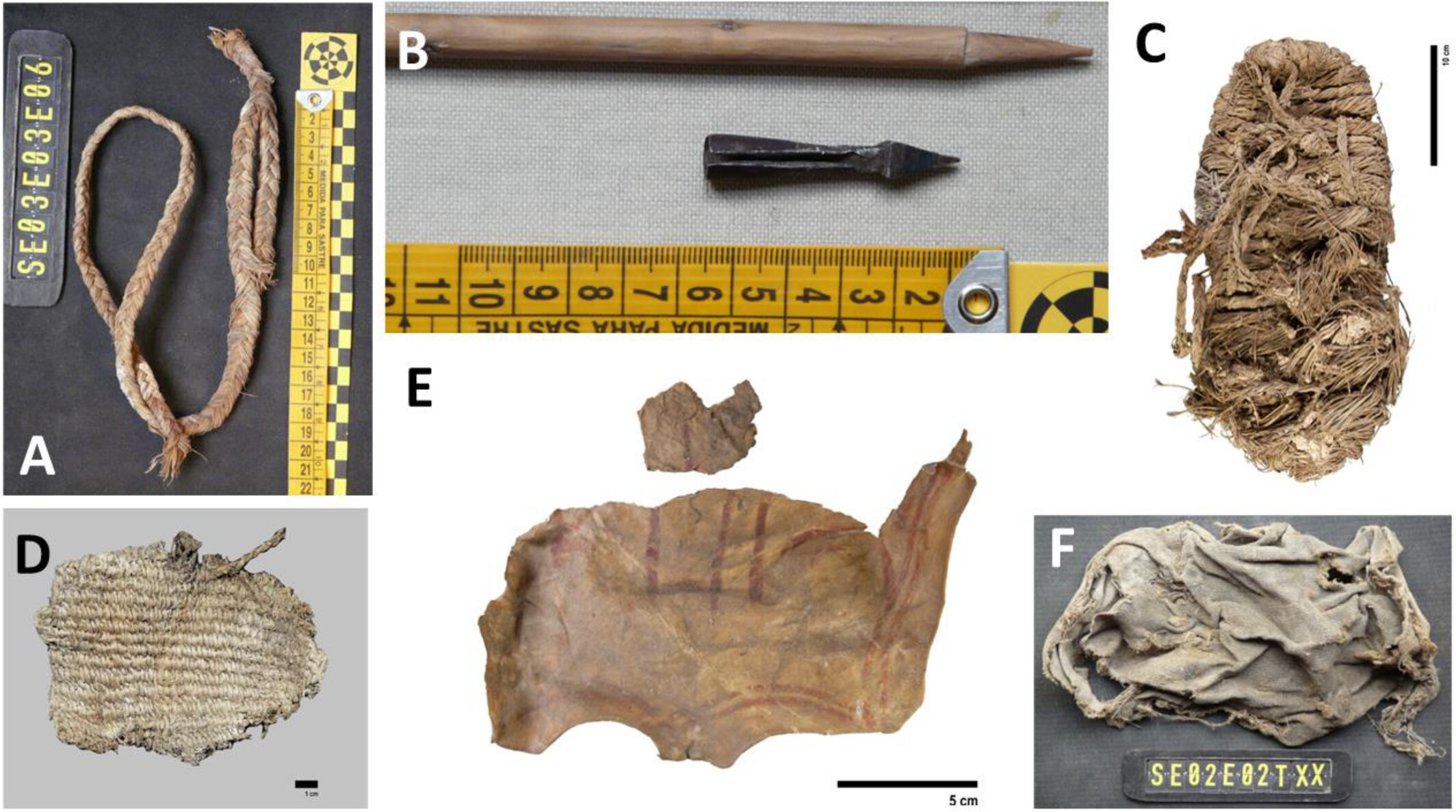
Among the artefacts, the researchers discovered extraordinary historical items made of esparto grass, a plant material widely used in the Iberian Mediterranean since the Epipalaeolithic, around 12,000 years ago. These human-made items reveal materials, craftwork, and uses spanning centuries.
Twenty‑five esparto objects were identified—basketry fragments, rope pieces, and cords—along with several agobías, the traditional footwear known as alpargatas. They also recovered 129 textile remains and 72 leather fragments. A particularly remarkable find was a crossbow bolt, highlighting the nests’ ability to preserve unexpected historical objects of great informational value.
Radiocarbon dating revealed that a basketry fragment dated to the 19th century, while a complete alpargata and a fragment of a mask decorated with red lines were more than six centuries old, placing them in the late 13th century.
“After performing proteomic analysis on the mask, we confirmed it was made of sheep skin; this technique, which consists of extracting proteins from biological materials to determine their species of origin, is one we frequently apply in our laboratory,” explains Ana B. Marín‑Arroyo. This new approach opens and consolidates a novel line of research that will strengthen bearded vulture reintroduction programmes in Spain, while also expanding our understanding of the bird’s behaviour as a biological agent in caves formerly inhabited by human groups.
Interdisciplinary implications
From an ecological perspective, the ungulate bone remains found provide valuable information about the species’ diet since medieval times, changes in its trophic spectrum, the environmental context, and the distribution and abundance of wild and domestic vertebrates. Eggshell remains will allow crucial comparative toxicological studies on pesticide loads—information of utmost importance for the species’ recovery in Europe and for selecting suitable release sites.
From an archaeological and ethnographic perspective, the accumulation of human artefacts offers insights into ancient technologies, changes in material culture, and the biocultural heritage of mountain areas.
The authors conclude that the bearded vulture can be considered an exceptionally valuable bioindicator for long‑term ecosystem monitoring and for advancing interdisciplinary research. They also stress the importance of studying the past and strengthening collaboration among specialists from different fields in order to build a more sustainable future—for ourselves and for the species with which we share the planet.